Andres J. Washington
FINGERPRINT GEOMETRIC ANALYSIS
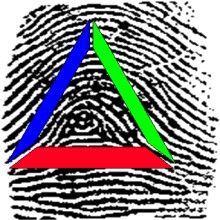
FINGERPRINT DIAGONAL REVERSE SEQUENCE ARRANGEMENT
Purpose and Innovative Aspects:
Copyright © Andres J. Washington
The original
sequence found in section “A” is for the sixty-four possibilities when the #
2,3,4,7,8 and 9 fingers are considered; this sequence only includes the inner
and outer loops. When a number is assigned to each box from left to right
and working down to the last box # 64, box 64 would equal:

Due to the fact that the inked
fingerprint is in actual reverse, (Mirroring) it has been determined that if
the sequence in section “A” was to be arranged to the sequence found in
section “B” it would then be in reverse displaying a different
perspective of the total possibilities in relation to each other. This
diagonal reverse is then used to provide the arrangement of the Second
Reference Sequence found in section “C”.
The second reference sequence
works as verification in its outcome of how the first reference sequence was
established. If the first reference sequence was not in proper
arrangement then the second reference sequence would not be in a uniform sequencing pattern. A close
examination of the fingerprint codes found in the second reference sequence
reveals a definite pattern along a diagonal basis.
For further analysis, the
second reference sequence has been divided into three areas; named area A, area
B, and area C. In area “A” the extreme diagonal of each box contains its
opposite code. In area “B” and “C” the extreme diagonal of each box
contains the same code in reverse.
Includes:
In the display of an extended geometric area for a given code, any code
which occupies the area by which two lines join together, forming an angle, or
any code which is used to create the lines which provide the design for the
given code in the original sequence, the first reference sequence and the
second reference sequence; is therefore included in the structure of that
code's design. All codes which are
included represent personalities that are compatible with one another. This is because all of the aforementioned
codes are required to create the geometric design.
Encompassed:
In the display of an extended geometric area for a given code, any
code(s) which are surrounded by the geometric design and is not included in the
makeup of that design and is not intersected by any of the lines which makeup
that design is therefore encompassed within the extended geometric area. Geometric codes which are encompassed
represent personalities that can be controlled by the personality of persons
who have the codes which are used to create the geometric design.
Intersected:
In the display of an extended geometric area for a given code, any code
which is crossed by the line(s) which make up the geometric design is in turn
intersected by those lines. The codes
which are intersected are the codes of persons who are incompatible with
persons who are represented by the codes which are used to create the geometric
design. This is because the intersection
of a code is an offence to the geometric position of that code.
Click here to view a display of the chart.
Click here for the Primary Classification First Reference Sequence.
What is the meaning of diagonal sequence?